
Understanding Biohazard Cleanup: Who Covers the Cost in Rental Properties?

Recent news is reporting that eviction filings within Arizona are on pace this year to be higher than the ‘Great Recession’ of 2007. Unfortunately, many tenants are sadly seeing suicide as their only solution when faced with an eviction notice. When this occurs, it creates a biohazard situation that must be addressed but the question that often comes up is, “who is responsible for the cost of the clean-up?”
When a tragic event like suicide occurs, it is important to approach this situation with compassion and sensitivity for all parties as these situations can also cause everyone to become emotionally charged. The property owner/manager/landlord may look at the hazard as having been created by the tenant, so it’s not their responsibility to pay for the remediation but that the family should. Same too for the family of the deceased – they didn’t create the issue and feel that the property owner has the responsibility to maintain the property while they work on making funeral arrangements for their loved one. So, who is correct?
While we are not providing a legal opinion here, in our experience within the state of Arizona we have found that ultimately the responsibility for cleaning up the rental property typically falls on the landlord (defined as a person who owns or runs a home, inn or similar establishment). Why do we say that? In general, a renter’s insurance is for their personal belonging and not the physical building. Whereas a landlord has a legal obligation to ensure the safety and habitability of the rental properties itself. Landlords must provide and maintain a structurally sound and safe living environment; this includes ensuring that the building's foundation, walls, roof, and floors are in good condition. In a biohazardous situation, such as a suicide, bodily fluids are essentially contaminating the property and the longer it goes before being remediated, the more potential there is for it to seep into the flooring or saturate the walls of the property.
While each situation is unique and can vary depending on local laws, the terms of the lease agreement, and the specific circumstances of the situation, a reasonable landlord would not want to rely on someone without professional experience to remediate these situations because, if not done properly, an unhealthy living arrangement could be left for current or future tenants and thus cause a potential legal issue for them in the future. Instead, it is prudent for the landlord to use their property insurance as it will typically cover biohazardous situations, with only the deductible amount being an out-of-pocket expense. Depending on the terms of the lease agreement, the deductible may even be held from the tenants deposit funds and thus is 'reimbursed' back to the landlord.
The bottom line is that ultimately the person that owns the property is the one responsible for ensuring the safety of current and future tenants in their exposure to biological contaminants present from a biohazard, such as a results from a suicide, within the residence.
T.A.C.T. 48 understands and hopes that this is the only time that a family member must deal with this kind of issue. When we first talk with our clients, we ask a series of questions to help determine and assess if the deceased was a renter or owner of the property and advise the family accordingly as to what the next steps should be for their specific circumstances. If you are ever in this situation, we are here to help 24/7/365 at (480) 740-6868.
T.A.C.T. 48 is ready to assist in Phoenix, Scottsdale, Tempe, Mesa, Gilbert, Chandler, Flagstaff, Prescott, Kingman, Sedona and throughout all of Arizona

For free and confidential emotional support 24/7 please call 988 for The National Suicide and Crisis Lifeline counselor assistance.
For more information visit Arizona Department of Health Services
Latest news
Read how T.A.C.T. 48 / AZ / Ft Worth's relentless hard work and innovative strategies have led them to be highlighted in a prestigious Esquire Magazine article.
Read More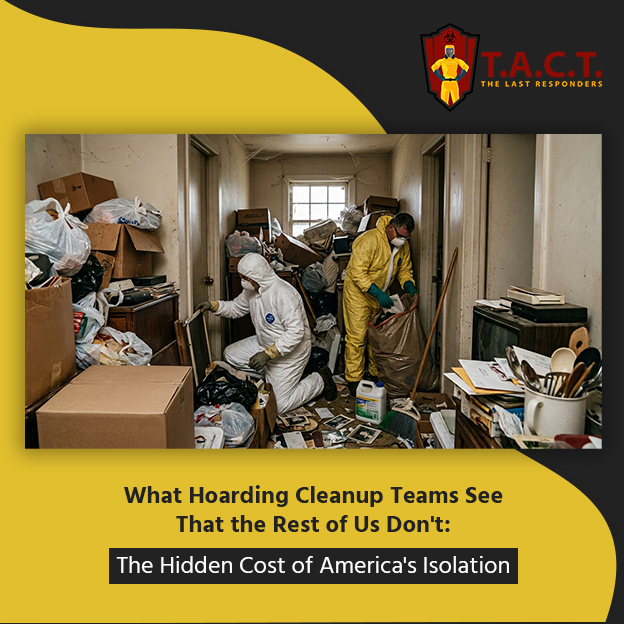
Following Esquire's recent look inside the world of trauma remediation, T.A.C.T. 48 founder David Lesaffre says the homes his teams enter reveal a deeper problem: what can happen when isolation, loss and disconnection accumulate behind closed doors.
Read More
Explore our blog's latest insights from July's Chronicles, featuring stories on who cleans up after the police leave, a day-in-the-life of our techinician and where does biohazardous waste go.
Read More